
Wednesday's hawkish and essentially courageous decision underscores that Governor Urjit Patel will largely represent continuity, rather than a break, with the policies and approach of his predecessor, says Richard Iley.

On the macro front, market participants will closely watch the FY'15 fiscal deficit target
.jpg)
A section of the market believes RBI should hold rates as negative real rates will hurt savings and investment.

HSBC on Monday lowered India's GDP forecast for the current financial year to 4 per cent from 5.5 per cent earlier saying economic uncertainty is likely to weigh on the growth forecast in the coming months.

Despite a strong start to trade today, key benchmark indices retreated sharply from their higher levels following bouts of profit-taking amid fresh weakness in the rupee against the dollar.
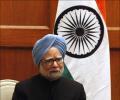
Experts say it will now be tough for the Modi government to catch up with the UPA's economic record owing to the shock induced by the currency demonetisation.

'Indians are great savers, but they are lousy investors.'

After a sharp sell-off in the past two months, overseas investors were once again seen turning bullish on Indian equities. FIIs bought shares worth Rs 63.5 billion in the past five sessions, their highest weekly investment tally in many months.

HSBC maintained "overweight" rating on Indian equities, saying "fundamentals are strong".

Bajaj Auto was the top gainer in the Sensex pack, surging 3.95 per cent followed by Maruti Suzuki at 2.69 per cent.

'It is a package for a new self-reliant India.'

The contract has not only cemented the position of its chief executive officer (CEO) Abidali Neemuchwala, it has also proven the ability of the current management to successfully chase and close larger deals that are becoming scarcer in the market.
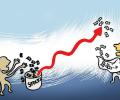
Small stocks made a dashing comeback in 2020 after delivering negative returns in the last two years as increased retail investor participation in pandemic times saw small-cap index surging up to 31 per cent and outperforming the bigger benchmark gauge. This year turned out to be eventful for the equity market, witnessing bearish and bullish sentiments at different points of time. While the initial part of COVID-ravaged 2020 saw the bears in full force amid concerns related to the pandemic and lockdowns hurting economic activities, bulls made a comeback towards the latter half of the year. As the market swayed with many lows as well as highs, small and mid-cap indices emerged as markets favourites in 2020.

The implications aren't too significant, given the size of Ukraine and its role in the global economy.

The Sensex has now lost 878.32 points in six sessions -- its longest string of losses in six months.
The combined share of customs and excise duties, service tax, and value-added tax in India's gross domestic product reached an all-time high of 10.5%.

Indian stock markets are likely to remain bullish during the current Hindu calendar year (Samvat 2071) and investors would continue to reap rich gains, say experts.

The bigger worry is that the miss for FY19 is likely to be significant even after assuming macro factors such as crude oil prices, rupee, input costs, and interest rates, do not worsen from the current levels, reports Vishal Chhabria.

A declining rupee, elevated crude oil prices and sustained foreign fund outflows added to the gloom

Experts say the BSE Sensex could rise to around 32,000 in a year.

A normal monsoon, softer interest rates and inflation, pent-up demand, along with mild budgetary support may help growth pick up in coming quarters.

The 50-stock NSE barometer Nifty finished 22.50 points, or 0.21 per cent, down at 10,526.20

Rise in investor sentiment, return of risk appetite aid shares across the board
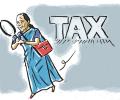
'If you do quick back-of-the-envelope calculation, someone earning Rs 10 lakh can get a benefit of anywhere between Rs 35,000 and Rs 45,000, even if s/he is availing exemptions.' 'A large proportion of people do not avail full exemptions as they don't have money to invest in those schemes.'
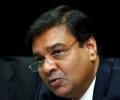
As inflation rate is near the upper limit of the comfort zone, experts rule out rate cuts anytime soon

Economist Deepak Nayyar says economic openness, while necessary, is not sufficient, and is conducive to development only when combined with industrial policy.
The BSE Mid-and Small-cap indices outperformed their larger peers rising 72 per cent and 52 per cent, respectively, during Samvat 2070.

The winter session of Parliament will commence on November 26.

As Nasdaq-listed company indicates poor spending in financial services space, Indian firms feel jittery

'India's relationship with China has been and will continue to be complex, delicate and sensitive,' says Rup Narayan Das.

TCS kicked-off the Q1FY17 earnings season for information technology companies on Thursday.

Tata Steel was the day's worst performer in the Sensex pack, plunging 3.25 per cent, followed by Bharti Airtel at 3.05 per cent.

Beijing did not announce expected policy support over the weekend

Despite the recovery to above $40 levels after hitting $28-29 in Jan, worries of over-supply in the face of weak demand remain.

After helping the government in policymaking since October 2014, Chief Economic Adviser Arvind Subramanian is returning to academics and will be teaching at Harvard Kennedy School on a visiting position. In an interview to Dilasha Seth and Somesh Jha, he says the ease of doing business agenda needs to move forward and India must try to integrate with the global value chains. Edited excerpts.

As regards India, market valuations already reflect most positives.

Industrialists affirm their belief that the adverse effects of demonetisation and the goods and services tax are finally over.

Does the rally reflect expectations of improving fundamentals or they are likely to correct?

April policy could be all about RBI communication.

2019 appears a story of two halves for Indian equities - a more difficult first half might precede a stronger second half, said Abhiram Eleswarapu, bottom, left, Head of India Equity Research, BNP Paribas in an interview with Ashley Coutinho.
 © 2026 Rediff.com - Advertise with us - Disclaimer - Privacy Policy - Sitemap - Feedback - About us - Terms of use - Grievances